
The Math Behind Amigurumi Shapes (and How to Make Your Own)
October 20, 2026
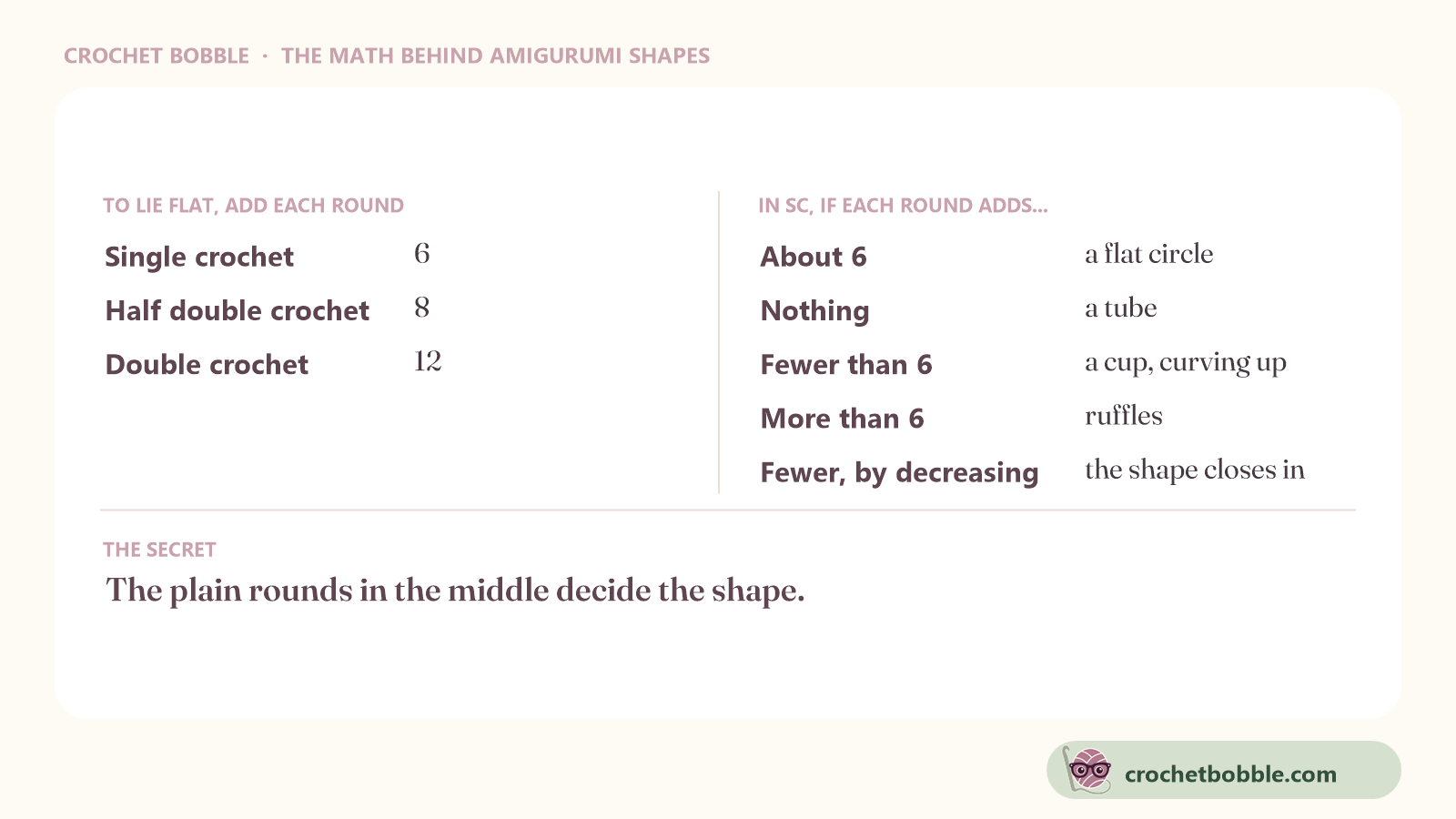
Every amigurumi, from a strawberry to a whale, is made of three moves: add stitches, keep the count, take stitches away. Once you see why the numbers are what they are, you can stop following shaping and start designing it.
Why six?
Start a single crochet circle and the pattern almost always says 6 sc in a magic ring, then 12, then 18, then 24: six more every round. That isn't tradition. It's geometry.
Each round sits one stitch-height further out than the one before it. A circle's circumference grows by about 6.28 (that's 2π) times however far out you step, so every round needs roughly six stitch-widths more than the last one to stay flat. A single crochet is about as tall as it is wide, so for single crochet that works out to six.
Taller stitches step further out each round, so they need more:
- Single crochet: 6 to start, 6 more each round.
- Half double crochet: usually 8 to start, 8 more each round (some designers use 10).
- Double crochet: 12 to start, 12 more each round.
Your own stitches nudge this. If your circle ripples at the edge, it has more stitches than it needs, so try fewer increases. If it starts to cup, try more.
Break the rule on purpose
That same rule is how every 3D shape works. In single crochet:
| If each round adds... | You get... |
|---|---|
| About 6 stitches | A flat circle |
| Nothing | A tube that stays the same size |
| Fewer than 6 | A cup, curving up |
| More than 6 | Ruffles that won't lie flat |
| Fewer, by decreasing | The shape closing back in |
A ball is just a few of those in a row: increase out to the widest point, work plain rounds, then decrease back in. Here's a small one in US terms, where inc means 2 sc in the same stitch and dec means sc2tog:
- Round 1: 6 sc in a magic ring. (6)
- Round 2: Inc in each st around. (12)
- Round 3: [Sc in next st, inc in next st] 6 times. (18)
- Round 4: [Sc in next 2 sts, inc in next st] 6 times. (24)
- Rounds 5–8: Sc in each st around. (24)
- Round 9: [Sc in next 2 sts, dec] 6 times. (18)
- Round 10: [Sc in next st, dec] 6 times. (12) Stuff firmly.
- Round 11: Dec 6 times. (6) Fasten off, thread the tail through the front loops of the last six stitches, and pull it closed.
The plain rounds in the middle decide the shape. Work more of them and your ball becomes an egg, then a capsule.
Three habits that make it look finished
- Work in a spiral, and mark the first stitch. Most amigurumi isn't joined at the end of each round. You just keep going, so a stitch marker in the first stitch of the round is the easy way to know where one round ends. Move it up as you go. Crochet Bobble's tracker keeps count of the round and the stitch you're on, and it remembers where each of your stitch markers sits and what color it is.
- Stagger your increases. Put the increase in the same spot every round and the corners stack into a hexagon. Shift where it falls, like [sc in next st, inc in next st, sc in next st] instead of [sc in next 2 sts, inc in next st], and the circle stays round. Both use the same number of stitches.
- Use the invisible decrease. Insert your hook into the front loop only of the next stitch, then the front loop only of the stitch after it. Yarn over and pull through both front loops, then yarn over and pull through the two loops on your hook. It tucks away where a standard sc2tog leaves a little bump.
One more: most amigurumi is worked on a hook a size or two smaller than the yarn label suggests. The denser fabric keeps the stuffing from showing through.
From an outline to rounds
Designing your own shape comes down to one question for every round: how big around is it here? Take the circumference at that height, divide by the width of one of your stitches, and that's your stitch count. The difference between one round's count and the next is how many stitches to add or take away, and spreading those evenly around the round gives you the pattern.
You can do that on paper. It's also exactly the kind of patient arithmetic a computer doesn't mind doing forty times.
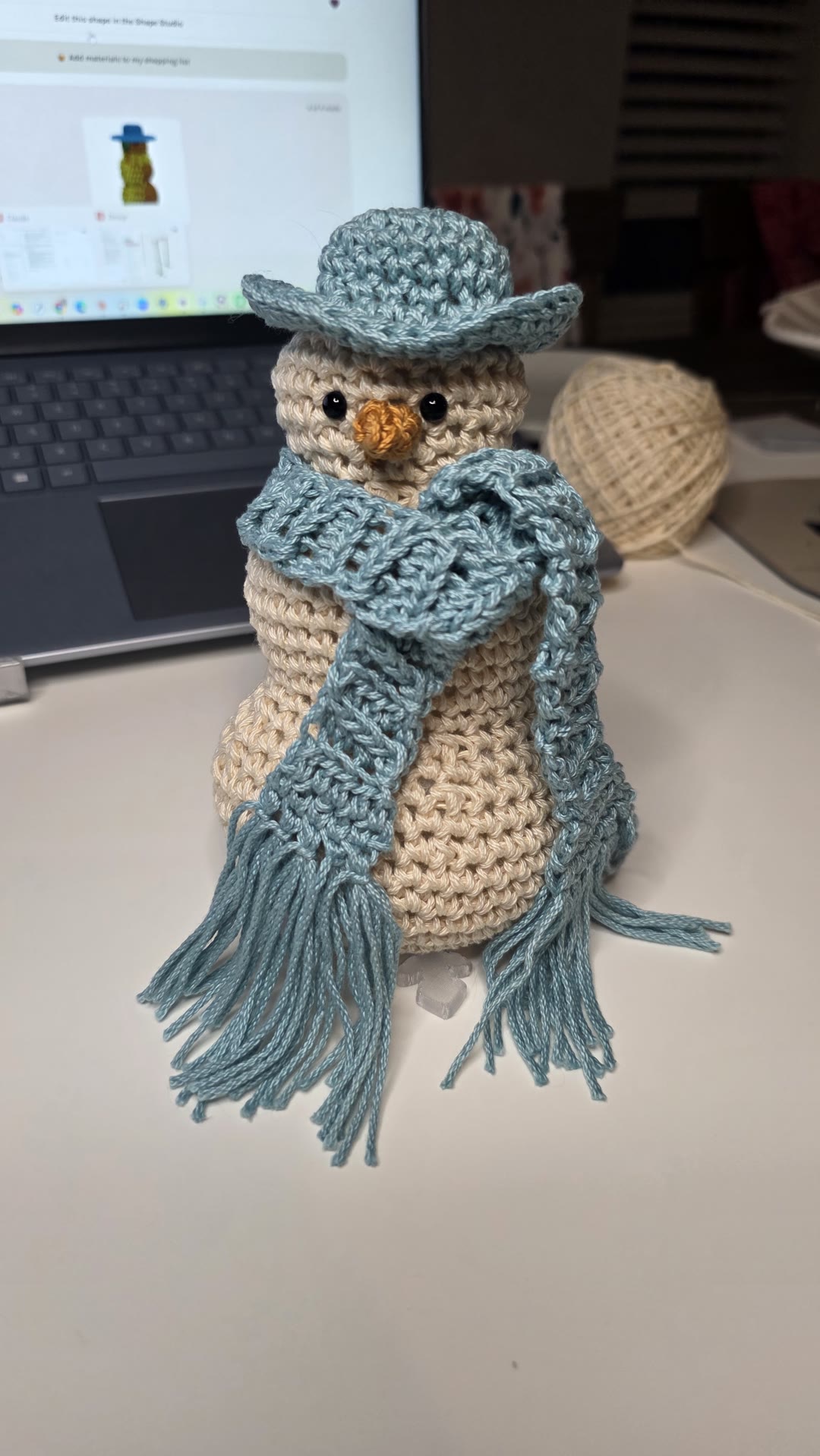
My little snowman started as a sketch in Shape Studio. That's his 3D version on the laptop behind him: body, hat, nose and scarf, each one its own piece.
Crochet Bobble's Shape Studio does that arithmetic for you: sketch the outline of the shape you want, and it works out the increase and decrease math for each round in single, half double or double crochet, then shows you the shape in 3D before you make a stitch. It's your shape and your idea; the app just does the counting. See what's in the toolbox.
Every tool you reach for, in one place
Crochet Bobble keeps what yarn you already own, which row you were on and how much a blanket will take — one app instead of a notebook and four others. The stitch school opens later, and joining now gets you both.
Crochet Bobble opens November 24 — waitlist members get 2 months free at launch, then the founder price of $7.99/mo for as long as you stay. US only for now.
Live somewhere else? Get an email when we open in your country.
It looks like you’re outside the United States. Crochet Bobble is only open in the US for now — the list for everywhere else will tell you when it opens where you live.
You’re on the list — thank you! Look for a note from hello@crochetbobble.com.
That didn’t go through. Please try again, or email hello@crochetbobble.com.
Notes from readers