
What Yarn Should You Buy for Your First Project?
September 22, 2026
You are standing in the yarn aisle. There are four hundred options, they are all beautiful, and not one of them says "buy me, you have been crocheting for six days."
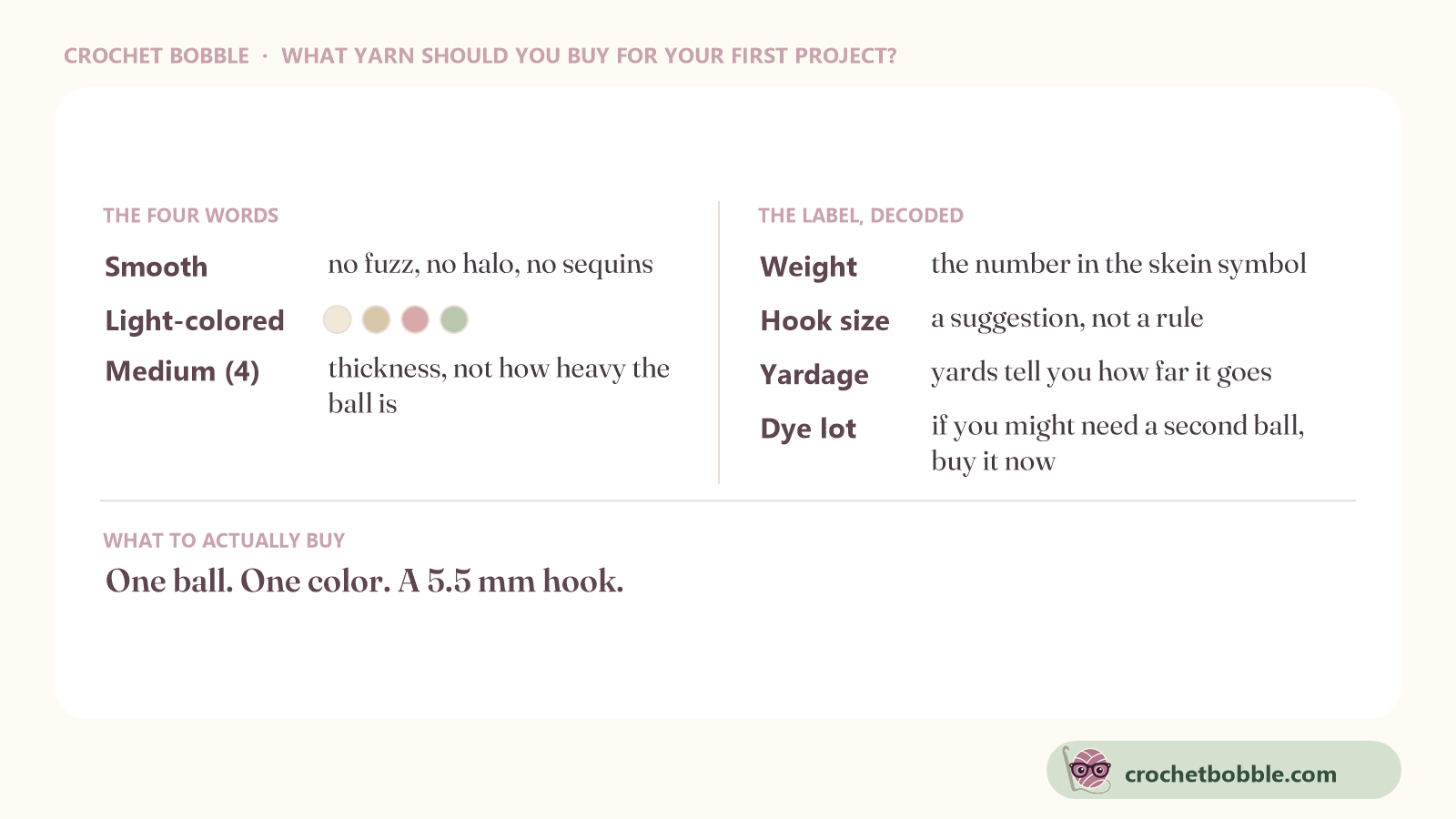
Here is the whole answer, and then why: smooth, light-colored, medium (4). Four words. You can leave now if you like.
Why those four words
Smooth means the yarn has no fuzz, no halo, no sequins and no boucle bumps. Textured yarn hides your stitches, and at this stage seeing your stitches is the entire job — you cannot fix what you cannot find. Save the fluffy one. It will still be there in a month.
Light-colored for exactly the same reason. Black yarn is beautiful and nearly unreadable under a lamp at nine at night. Cream, oatmeal, dusty pink, pale sage — anything where the loops cast a visible shadow.
Medium (4) is the weight number, and it is the most useful thing on the whole label. Weight means thickness, not how heavy the ball is. Medium sits right in the middle: thick enough that a row takes a satisfying amount of time, thin enough that the fabric doesn't fight you. Our yarn weight chart has all eight, if you want to see where it falls.
The label, decoded
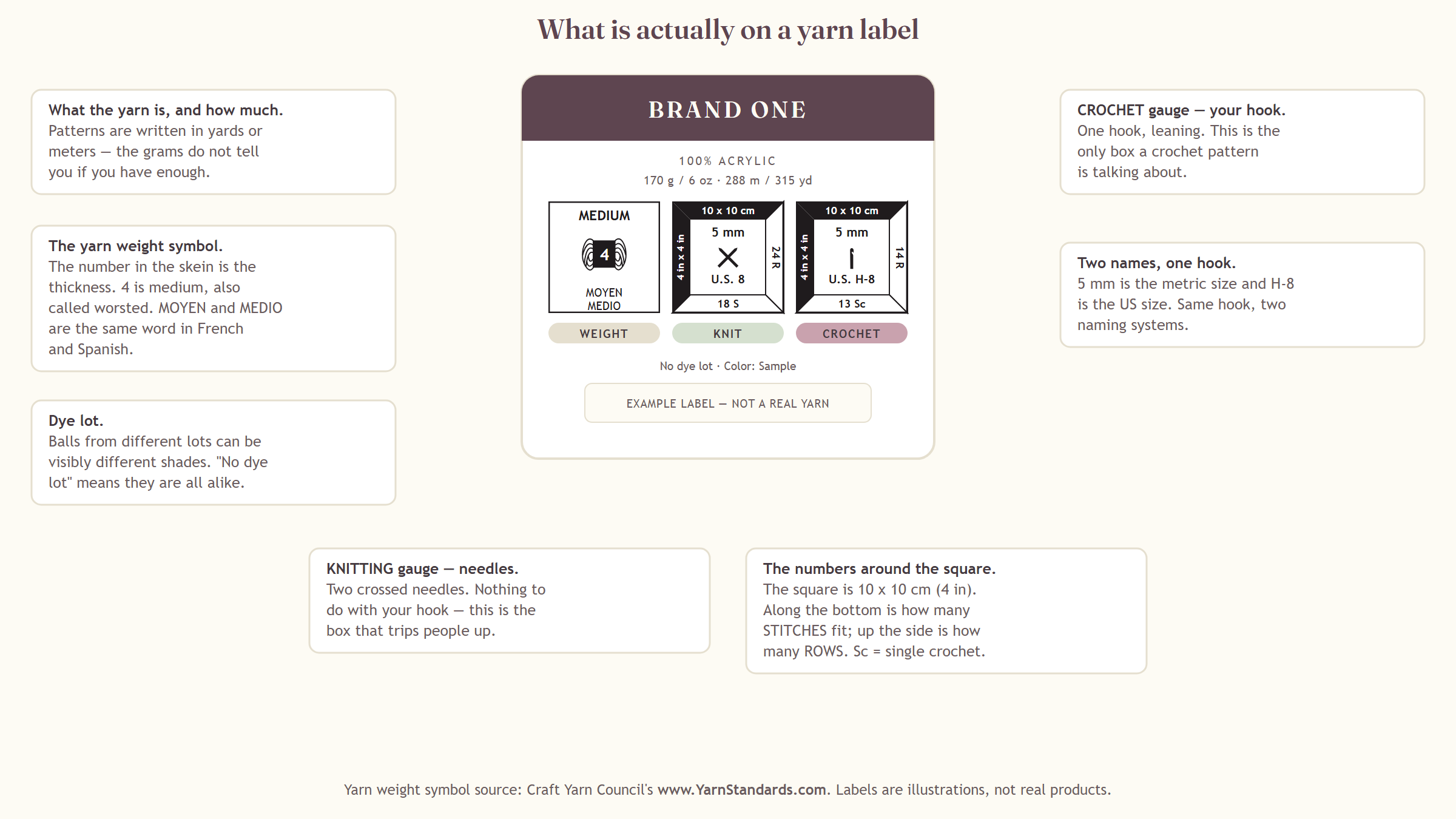
Yarn bands look like a customs form, but only four things on them matter today.
The number in the little skein symbol is the weight — that's your 4.
The hook size is a suggestion, not a rule. It is the size that gives average tension, and yours is not average yet. Take it as a starting point. (Ours is the full hook chart if the letters and numbers on your hook disagree with each other, which they will.)
The yardage is the number that actually matters when a pattern says how much you need. Grams tell you what the ball weighs; yards tell you how far it goes. Two 100-gram balls in different fibers can hold noticeably different lengths of yarn.
The dye lot is a small number that means "this ball was dyed in the same batch as that one." Two balls of the same shade from different lots can be very slightly different, invisible in the shop and painfully visible across a finished blanket. If you might need a second ball, buy it now.
Fiber, quickly
Acrylic is what most people learn on, and there is no shame in it: it is cheap, it comes in every color, it survives a washing machine, and if the first thing you make is terrible you have lost a few dollars.
Cotton is lovely for anything that meets water — washcloths, market bags, coasters. It has almost no stretch, which makes it slightly less forgiving of tight hands.
Wool is warm, springy, and the most pleasant of the three to work with. It also costs more, and unless the label says superwash it usually wants hand washing, so it is a reward rather than a first purchase.
What to actually buy
One ball. One color. A 5.5 mm hook.
Not a set of twenty hooks in a zippered case, not the variegated one that changes color on its own, not enough yarn for a blanket. One ball is enough to make several small things, discover what your hands do, and find out whether you like this — which is the only question the first purchase has to answer.
If you fall in love, the yarn shop will still be there. It always is.
Crochet Bobble keeps your yarn straight once you have some — what's in your stash, a shopping list built from a pattern's materials, and which patterns use the weight you already own — so your next trip down the yarn aisle starts with a list.
Every tool you reach for, in one place
Crochet Bobble keeps what yarn you already own, which row you were on and how much a blanket will take — one app instead of a notebook and four others. The stitch school opens later, and joining now gets you both.
Crochet Bobble opens Winter 2026 — waitlist members get 2 months free at launch, then the founder price of $7.99/mo for as long as you stay.
You’re on the list — thank you! Look for a note from hello@crochetbobble.com.
That didn’t go through. Please try again, or email hello@crochetbobble.com.
Want to help build it? Apply to be a beta tester →
Notes from readers