
Two Hooks, Same Letter, Different Size
September 29, 2026
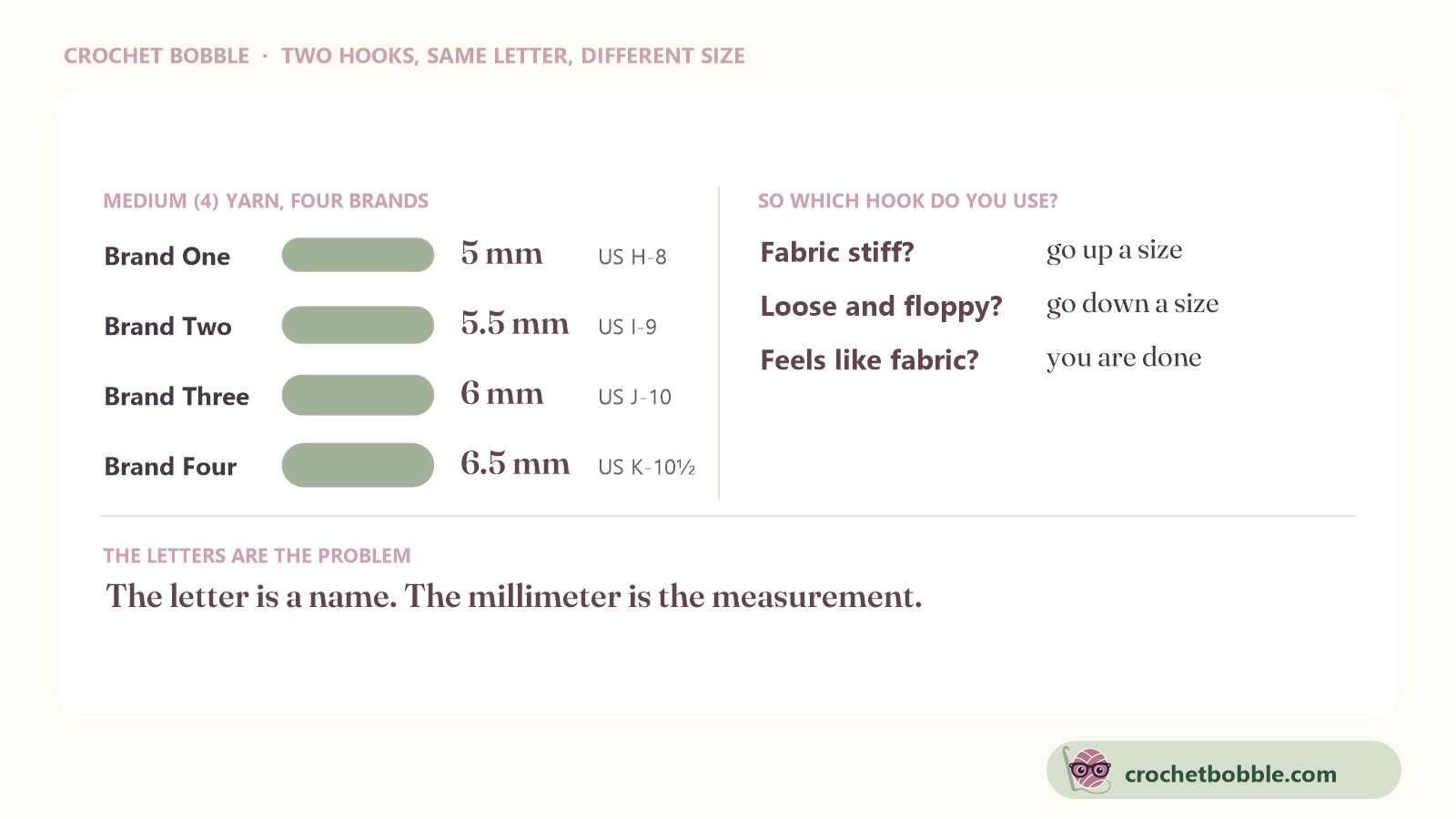
Buy four balls of medium (4) yarn from four different brands and read the hook size on each band. You may well get three or four different answers.
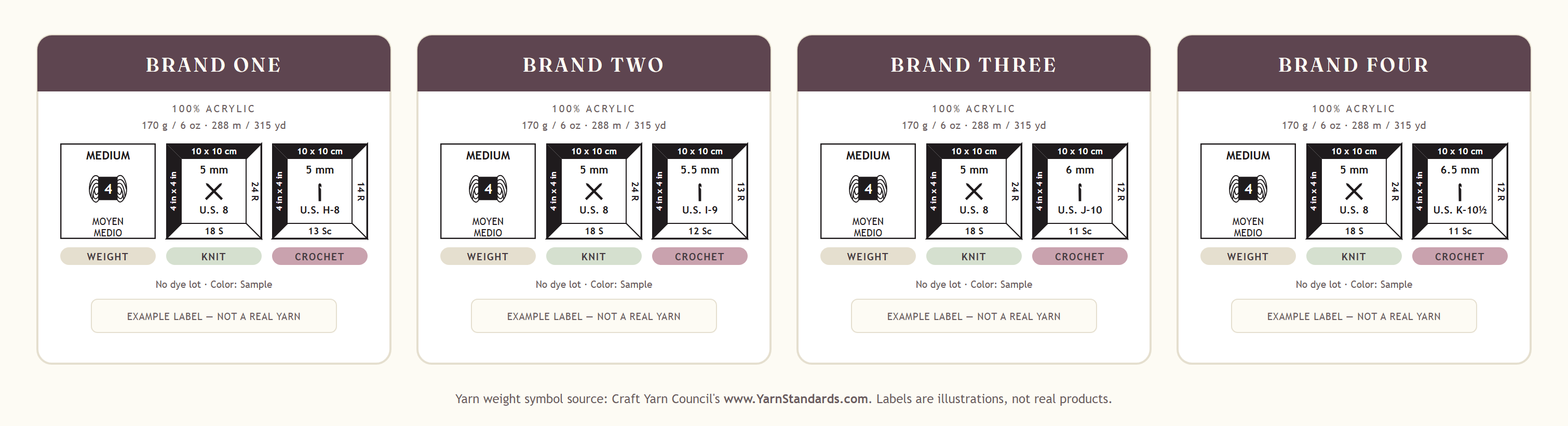
The labels in that picture are illustrations, but the disagreement is real: the one on my shelf says 5 mm, while the Craft Yarn Council's range for medium (4) runs 5.5 to 6.5 mm. That is a genuinely different fabric at either end. Nobody is wrong. There is just no rule saying they have to agree.
The letters are the problem
American hooks carry a letter and a number together — 4 mm is a G-6, 5 mm is an H-8, 5.5 mm is an I-9. The letter is not a measurement. It is a name, and different manufacturers have given the same name to slightly different hooks.
The millimeter is the measurement. On most modern hooks it is stamped on the shaft or the handle, it means the same thing in every country, and when a pattern and a label disagree about a letter, the mm is the one telling the truth. That is why every chart we publish leads with it, and why our hook chart answers "what size is a G hook in mm" for every letter rather than making you read a table sideways.
If you own one hook and one pattern and they use different systems, look at the shaft or the handle. On most hooks made today, the number is there.
So which hook do you use?
Start with what the yarn band says, then change it based on what comes out.
That second half is the part nobody tells beginners, and it is not cheating — it is the actual skill. The label assumes average tension. Yours is whatever it is, and for most people at the start it is tight.
- Fabric stiff, hook hard to push in? Go up a size. A bigger hook makes bigger loops without you having to relax on command, which nobody can do anyway.
- Fabric loose and floppy, gaps you didn't plan? Go down a size.
- Fabric feels like fabric? You are done. That is the whole test.
We wrote more about the tight-hands phase in why crochet curls, because it is the single most common reason a first square won't lie flat.
The one exception worth knowing
Steel hooks are numbered backwards. They are the very fine ones for thread crochet and lace, and on those a bigger number means a smaller hook — a steel 14 is thinner than a steel 1. It catches everyone once.
You almost certainly do not need one yet. But if you inherit a tin of hooks from somebody's grandmother, some of them will likely be steel, and now you know why the numbering looks broken.
What to buy
One 5.5 mm hook. It suits medium (4) yarn, which is what most beginner patterns assume, and it is big enough to see what your hands are doing.
Not the set of twenty in a zippered case. You will use three of them this year, and you cannot tell yet which three.
Aluminum is fine. An ergonomic handle is genuinely nicer if your hands ache, and genuinely optional if they don't.
Crochet Bobble knows which hook and yarn you picked for a project, and once you've logged a few gauge swatches, its size estimates answer for your hands rather than an average pair.
Every tool you reach for, in one place
Crochet Bobble keeps what yarn you already own, which row you were on and how much a blanket will take — one app instead of a notebook and four others. The stitch school opens later, and joining now gets you both.
Crochet Bobble opens Winter 2026 — waitlist members get 2 months free at launch, then the founder price of $7.99/mo for as long as you stay.
You’re on the list — thank you! Look for a note from hello@crochetbobble.com.
That didn’t go through. Please try again, or email hello@crochetbobble.com.
Want to help build it? Apply to be a beta tester →
Notes from readers