
How to Crochet a Graphghan Without Losing Your Place
October 13, 2026
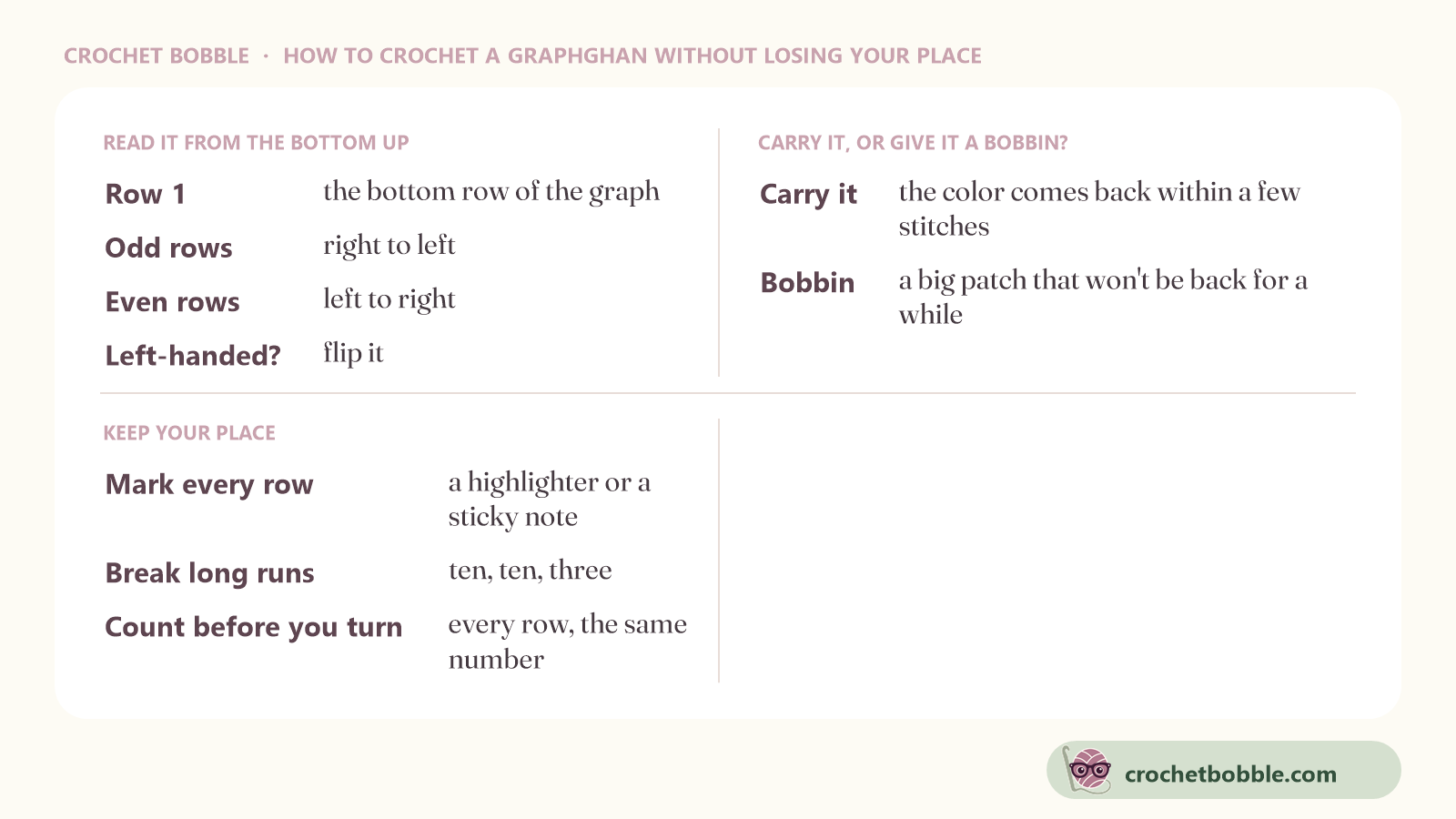
A graphghan is a blanket worked from a picture on graph paper. Every square on the graph is one stitch (or, in C2C, one small tile), and the colors add up to the picture. If you can single crochet and change colors, you can make one.
The stitching isn't the hard part. Keeping track is — of the row, of the color, and of which of five dangling strands you're supposed to pick up next.
Read the graph from the bottom up
For a graphghan worked in rows, Row 1 is the bottom row of the graph, because that's the edge you start with. If you crochet right-handed, read Row 1 from right to left, the same direction your stitches travel. Turn your work, and Row 2 reads left to right. Odd rows right to left, even rows left to right, all the way up.
Crochet left-handed? Flip it: your odd rows read left to right.
The mistake everyone makes once is reading every row in the same direction. The picture comes out scrambled, and you won't see it until you're a dozen rows in.
Your stitches aren't squares
Graph paper is. That mismatch is the surprise.
One yarn label on my shelf promises 13 single crochet and 14 rows to 4 inches, which means rows a little shorter than the stitches are wide. When I measured my own single crochet swatches, they came out the other way: my rows were a little taller. Half double crochet is taller again. My Ford square is 20 stitches by 20 rows of hdc, and with its border it finished at 8½ by 9½ inches. A perfectly square chart made a square that is taller than it is wide.
Neither answer is wrong. It depends on your yarn, your hook and your hands. So before you chart a face or a name, crochet a small swatch in the stitch you'll use and count both directions over 4 inches: stitches across, rows up. If the two numbers don't match, your picture will stretch the same way, and now you know before row one instead of after row eighty. (The gauge calculator does the arithmetic if you'd rather not.)
Pick your stitch
- Single crochet is the densest and the closest thing crochet has to a pixel. The picture comes out sharpest, and it takes the most stitches.
- Half double crochet is taller, so a blanket the same size takes fewer rows. Chart it for hdc, though, or a square picture comes out stretched tall.
- Corner to corner (C2C) is worked diagonally in small tiles, each one three double crochet and a chain-3, and each tile is one square of the graph. You start at one corner and add a tile every row until you reach a side edge. On a square, you then take one away each row until you reach the far corner; a rectangle has a middle stretch where you add a tile at one edge and take one away at the other. It covers ground quickly, and the tiled texture becomes part of the look.
Change color one stitch early
Work the last stitch in the old color until only its final yarn over is left, then pull that yarn over through with the new color. It feels a stitch too soon, and it's what keeps the line between two colors crisp.
Carry it, or give it a bobbin?
Two ways to handle the color you aren't using:
- Carry it (tapestry crochet). Lay the unused strand along the tops of the stitches and crochet right over it, so it rides inside your work. No loose strands and far fewer ends to weave in, but the carried color can peek through between stitches, and the fabric gets thicker and stiffer.
- Give it a bobbin (intarsia). Drop the strand you aren't using where it is, and pick it back up when you reach that spot on the next row. The fabric stays soft and the colors stay clean, but you have more strands to manage and more ends at the finish.
Carrying makes sense when a color comes back within a few stitches. For a big patch that won't be back for a while, a bobbin is kinder to the fabric. You can use both in the same blanket.
Count strands, not colors. A white background with a red heart in the middle needs a white strand on each side of the heart: two white and one red, for a single row. Before you start, find your busiest row and count its separate patches of color. That's how many strands you'll be juggling. (Crochet Bobble counts them for you, and tells you which bobbin comes next.)
Weaving in ends every few rows beats facing all of them on the last day.
Keep your place
This is the real work of a graphghan:
- Mark every finished row. A highlighter on a printout, or a sticky note you move up as you go. Anything that stops you working Row 34 twice.
- Break long runs into tens. "Twenty-three white" is easy to lose halfway. Ten, ten, three is not.
- Count the row before you turn. In a graphghan worked in rows, every row of a rectangle has the same number of stitches. One extra or one missing is a slanted edge in the making, and it's far easier to fix now than twenty rows later. Counting stitches has its own post, because it's worth one.
Or put the highlighter down and let the app keep track. In Crochet Bobble, the chart fills in with your colors as you work, and a star marks exactly where you are. Underneath, it tells you how many stitches are left in the row and in the color you're holding, and it can count long runs in groups of ten for you. Put it down for a week, open it with no signal, and your place is still there.
Crochet Bobble turns a photo into a graphghan chart in single crochet, half double or C2C, lays out every row with its color changes, tells you how many strands each color needs, and fills the chart in as you work, so your place is always marked.
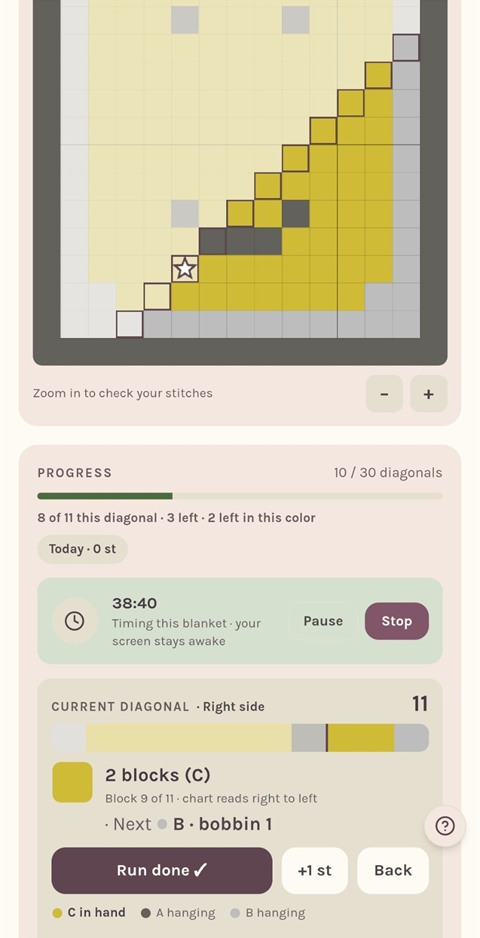
Partway through a corner-to-corner blanket: diagonal 11 of 30, two more blocks of C, then B from bobbin 1.
Every tool you reach for, in one place
Crochet Bobble keeps what yarn you already own, which row you were on and how much a blanket will take — one app instead of a notebook and four others. The stitch school opens later, and joining now gets you both.
Crochet Bobble opens Winter 2026 — waitlist members get 2 months free at launch, then the founder price of $7.99/mo for as long as you stay.
You’re on the list — thank you! Look for a note from hello@crochetbobble.com.
That didn’t go through. Please try again, or email hello@crochetbobble.com.
Want to help build it? Apply to be a beta tester →
Notes from readers