
How to Read a Crochet Pattern
October 6, 2026
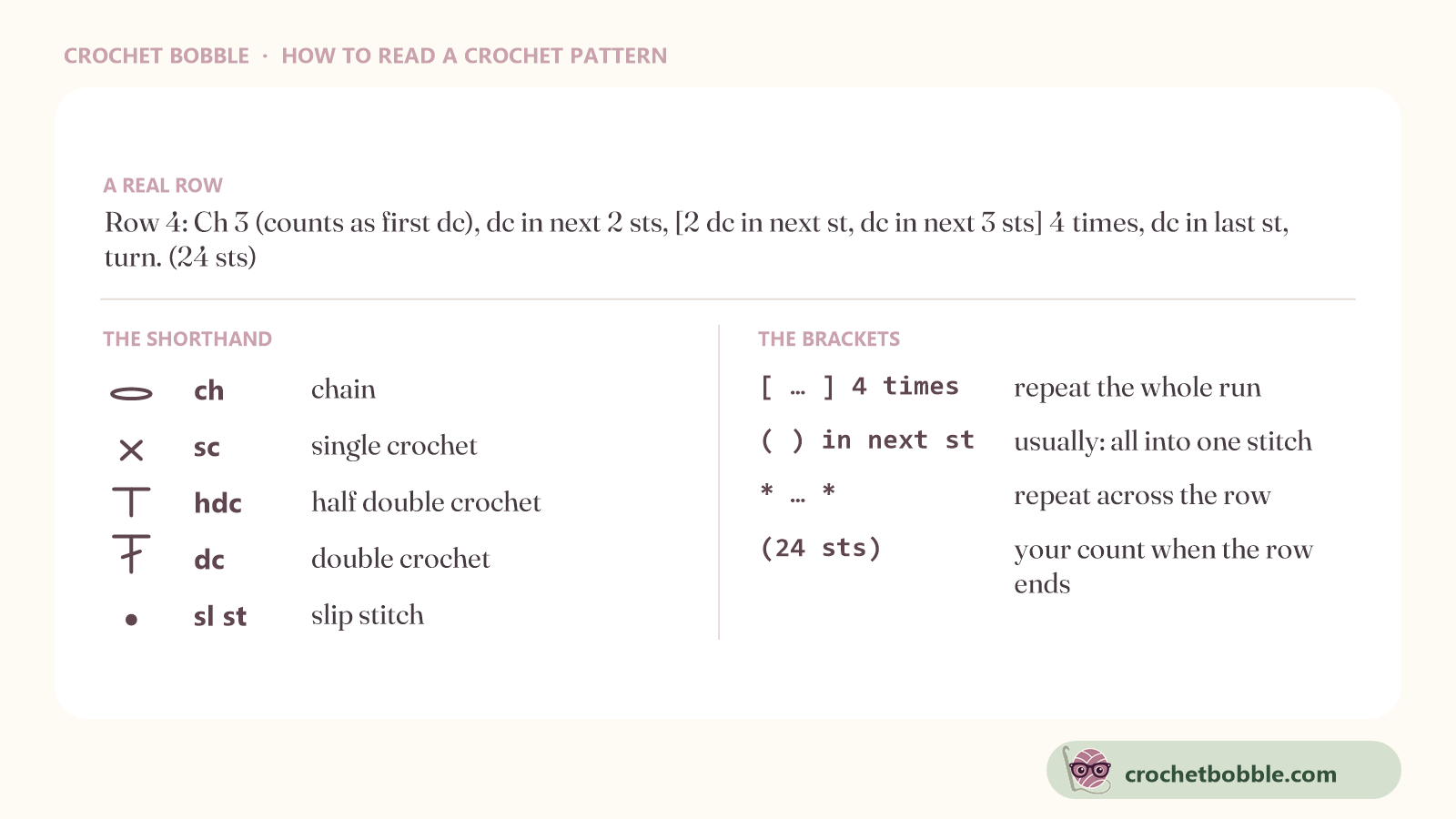
A crochet pattern is a language with a small vocabulary, and many patterns assume you already speak it.
Row 4: Ch 3 (counts as first dc), dc in next 2 sts, [2 dc in next st, dc in next 3 sts] 4 times, dc in last st, turn. (24 sts)
That is not difficult. It is just compressed, and nobody hands you the key.
The abbreviations
The short ones do most of the work:
- ch — chain
- sc — single crochet
- hdc — half double crochet
- dc — double crochet
- sl st — slip stitch
- st / sts — stitch, stitches
- sk — skip
- rep — repeat
- tog — together. Usually a decrease (dc2tog = two double crochets worked together into one), but when every leg goes into the same stitch it makes a cluster instead.
That is genuinely most of them. Our abbreviations chart has the rest when you meet one that isn't here.
Brackets mean two different things
This is the part that trips people up, because the two symbols look alike and usually mean different things.
Square brackets repeat a sequence. [2 dc in next st, dc in next 3 sts] 4 times means do that whole run, then do it three more times.
Round brackets usually mean everything inside goes into one stitch. (3 dc, ch 3, 3 dc) in next ch-sp is a shell — all of it, into the same spot. The Craft Yarn Council also allows round brackets as a repeat, so if what's inside can't all go into one stitch, look for a number after them.
Some patterns also use an asterisk (*) to mark a repeat across a row. If a pattern's stitch count stops working, check which convention it is using before you assume you miscounted.
The number at the end of the row
(24 sts) is the pattern telling you how many stitches you should have when that row is finished.
Use it. Every time. It is the only error-checking a written pattern gives you, and it turns a wrong row into a ten-second problem instead of a six-row one. If your count doesn't match, check the row you just did before you blame the pattern. (We wrote about where stitches actually go missing in how to count crochet stitches.)
The turning chain, and why it is confusing
At the start of a row you chain a few to get up to the height of the stitches you are about to make. The chain is the little lie in every pattern: sometimes it counts as the first stitch and sometimes it doesn't.
A ch 3 before double crochets usually counts as the first dc — which is why the pattern above says so in brackets. A ch 1 before single crochets does not. When it counts, you skip the first stitch of the row; when it doesn't, you work into it.
Both conventions are real and published, so a good pattern tells you which one it means. If yours doesn't, the stitch count at the end of the row will settle it.
Before stitch one, check the dialect
Read the pattern for the letters sc. If they are there, it is American. UK terminology has no single crochet at all, and every UK stitch name above slip stitch sits one step up the ladder — their double crochet is our single. Follow a UK pattern with US definitions and every stitch comes out one size too tall: a hat that fits a beach ball.
We wrote a whole post on that: US vs UK crochet patterns. The terms chart is the one to keep open beside anything you're unsure of.
And if it is a chart instead of words
Some patterns are drawn rather than written — a picture of the fabric, one little symbol per stitch. The basics take an evening to learn, and then it works in any language, because the symbols are far closer to universal than the words are. The symbols guide is free and open in a tab.
Crochet Bobble reads patterns with you — an abbreviation key for every stitch the pattern uses, the row you are on held in place, and a stitch counter that keeps count as you go — so a pattern is something you follow rather than decode.
Every tool you reach for, in one place
Crochet Bobble keeps what yarn you already own, which row you were on and how much a blanket will take — one app instead of a notebook and four others. The stitch school opens later, and joining now gets you both.
Crochet Bobble opens Winter 2026 — waitlist members get 2 months free at launch, then the founder price of $7.99/mo for as long as you stay.
You’re on the list — thank you! Look for a note from hello@crochetbobble.com.
That didn’t go through. Please try again, or email hello@crochetbobble.com.
Want to help build it? Apply to be a beta tester →
Notes from readers