
What Is Gauge in Crochet (and Do You Really Need a Swatch?)
November 3, 2026
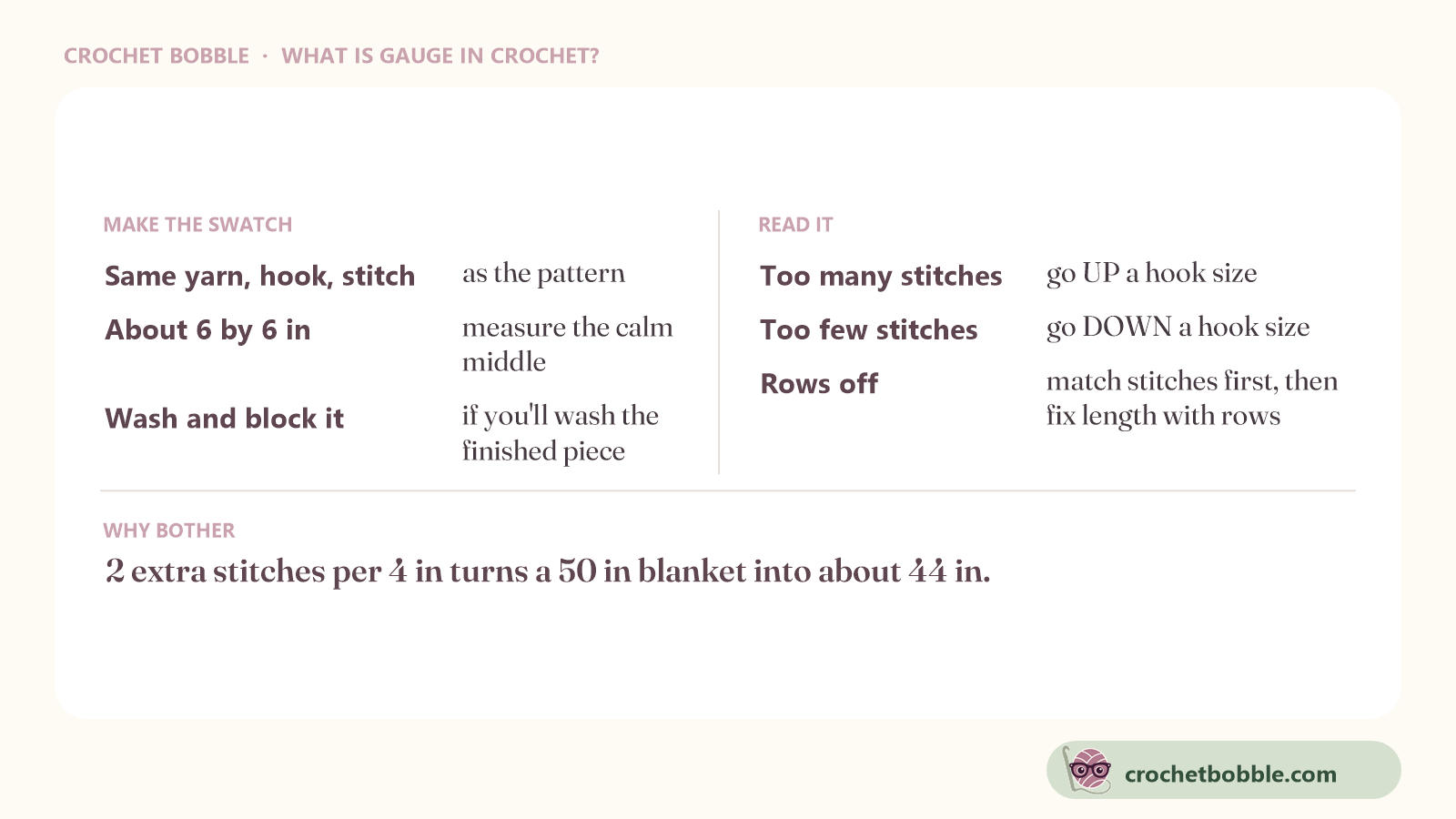
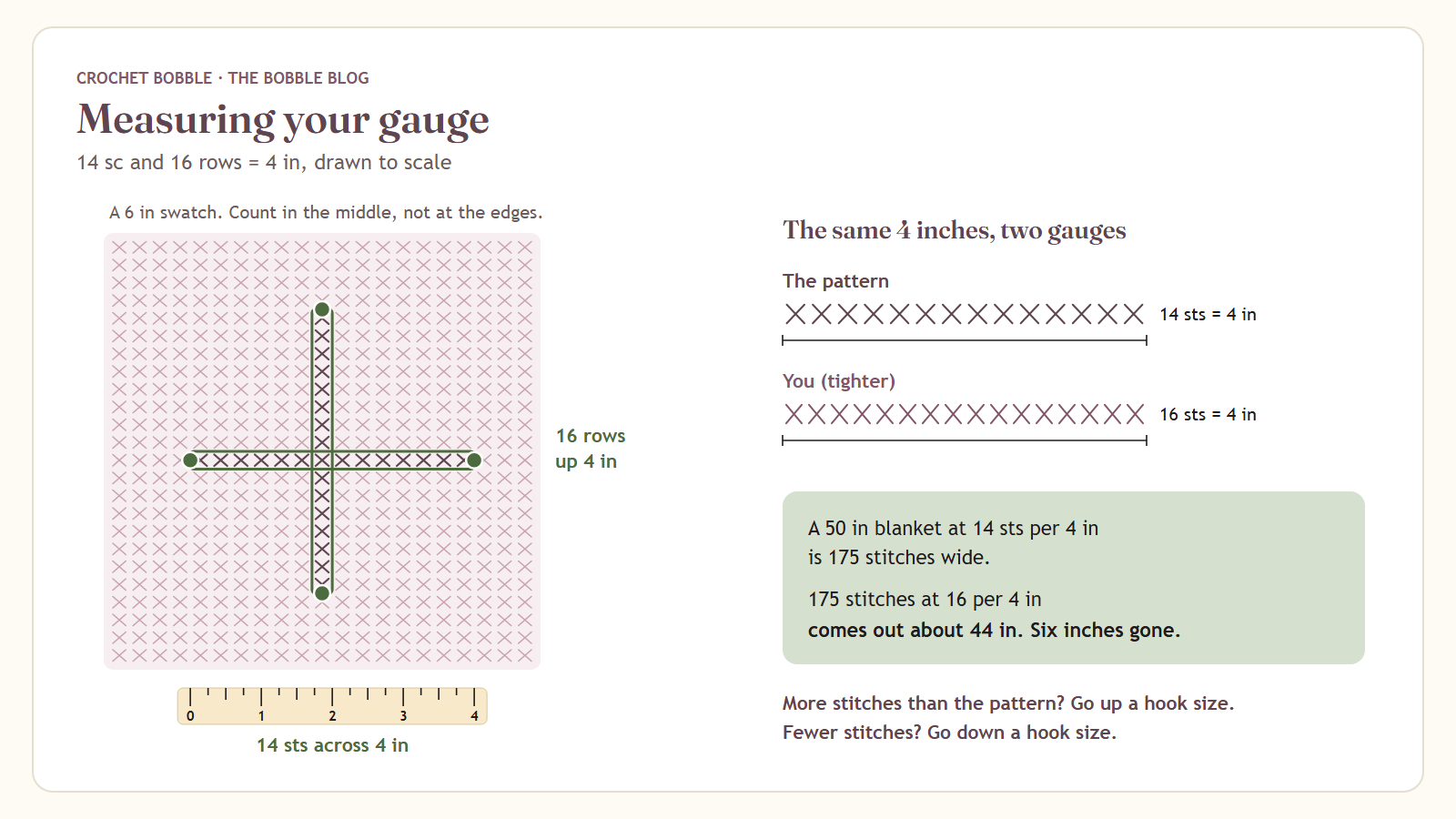
Gauge is how many stitches and rows fit in a set space, usually 4 inches. A pattern might say "14 sc and 16 rows = 4 in." That one line is the designer telling you how tightly they crochet.
Your hands and theirs aren't the same. If you crochet tighter, every stitch comes out a little smaller, and a little times a few hundred stitches adds up fast.
Why it matters
Say a blanket pattern is 50 inches wide at 14 stitches per 4 inches. If you get 16 stitches in 4 inches instead, your blanket comes out about 44 inches wide. Six inches gone, and you followed every row exactly.
It cuts the other way too. Crochet looser than the designer and your project grows, and so does the yarn it eats. Run out of a color halfway through and the store may not have that dye lot anymore. Gauge is the cheapest insurance you'll ever buy.
How to make a swatch that tells the truth
- Use the pattern's yarn, hook and stitch. A swatch in single crochet tells you nothing about a shell-stitch shawl.
- Make it bigger than 4 inches. Aim for about 6 by 6. The edge stitches are always a little wonky, and you want to measure from the calm middle.
- Treat it like the finished piece. If you'll wash and block the blanket, wash and block the swatch. Some yarns relax and grow once they get wet, and you want to know that now.
- Lay it flat without stretching it. Let it sit for a few minutes before you measure.
- Count in the middle. Put a stitch marker or pin at the start of a 4-inch span, another at the end, and count the stitches between them. Do the same up and down for rows. Half stitches count, so write down 13.5 if that's what you see.
Too many or too few?
- More stitches than the pattern means your stitches are smaller. Go up a hook size.
- Fewer stitches than the pattern means your stitches are bigger. Go down a hook size.
Make a new swatch after each change. One hook size often moves you about a stitch or so per 4 inches, but that's a rule of thumb, not a promise.
Match the stitch count first. Row gauge is harder to change with the hook, and for anything you work "until it measures 12 inches" you'll fix the length by adding or leaving out rows anyway.
And go by the millimeters on the hook, not the letter. Letters vary from brand to brand, so 5.5 mm is the same size everywhere and an "I" might not be. Our hook size chart has every size side by side.
When you can skip it
Honestly? Sometimes.
- Amigurumi. Size rarely matters, but tightness does. You want fabric dense enough that stuffing doesn't show through, so most people go down a hook size or two from the label and call it done.
- Dishcloths, scarves and wraps where a little bigger or smaller won't bother anyone.
Even then, a quick swatch tells you how much yarn you're really going to use, which matters most on the big projects people are most tempted to skip it on.
Do the math once
If your gauge doesn't match and you love your fabric the way it is, you don't have to change hooks. Do the math instead. Our free crochet gauge calculator takes your swatch and the size you want and tells you how many stitches and rows to make.
Crochet Bobble opens November 24 in the US. Once it does, a membership lets you save your own gauge on a pattern you're charting, and the rulers along a row chart come from how you crochet, not a stranger's tension. Join the waitlist (US only).
Every tool you reach for, in one place
Crochet Bobble keeps what yarn you already own, which row you were on and how much a blanket will take — one app instead of a notebook and four others. The stitch school opens later, and joining now gets you both.
Crochet Bobble opens November 24 — waitlist members get 2 months free at launch, then the founder price of $7.99/mo for as long as you stay. US only for now.
Live somewhere else? Get an email when we open in your country.
It looks like you’re outside the United States. Crochet Bobble is only open in the US for now — the list for everywhere else will tell you when it opens where you live.
You’re on the list — thank you! Look for a note from hello@crochetbobble.com. Don’t see it in a few minutes? Peek in your spam or promotions folder, and mark it “Not spam” so the next ones find you.
That didn’t go through. Please try again, or email hello@crochetbobble.com.
Notes from readers