
How to Write a Crochet Pattern Other People Can Follow
October 27, 2026
You made something without a pattern. Somebody asked how. Now what your hands know has to become words a stranger can follow, and that's a different skill from crocheting.
The good news is that patterns follow conventions, and the Craft Yarn Council (CYC) publishes the standard ones. Stick to them and your reader already knows how to read what you wrote.
What goes at the top
Before Row 1, a crocheter needs to know whether they can make this and what they need. Roughly in this order:
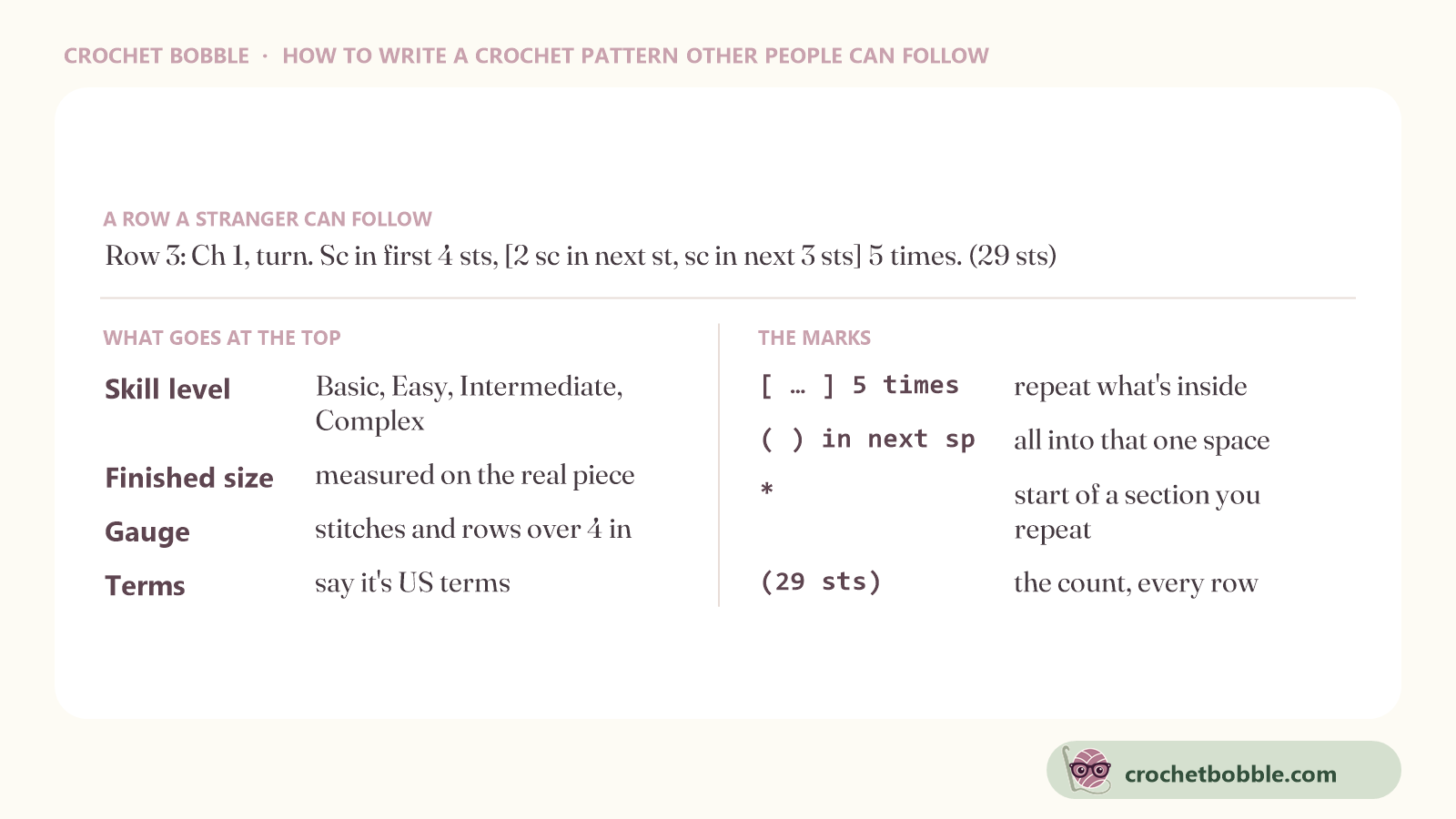
- Skill level. The CYC uses four for crochet: Basic, Easy, Intermediate and Complex. Basic means basic stitches, maybe a few simple increases and decreases; Complex means several techniques and stitches at once.
- Finished size. Measured on the real piece, not estimated, and say where you measured it.
- Yarn. The weight by its number, like medium (4), plus the fiber, how many yards you used, and the exact yarn you made it with. Our yarn weight chart has every weight's number.
- Hook. Millimeters first: 5.5 mm (US I-9). US letters vary from brand to brand, and the millimeter never does.
- Gauge. Stitches and rows over 4 inches, in the stitch the pattern actually uses. A gauge in single crochet doesn't help somebody checking a shell-stitch shawl.
- Terms. Say you're writing in US terms. A UK treble is a US double, and a reader who guesses wrong makes a different fabric.
- Notes. Anything that applies to every row: whether the turning chain counts as a stitch, whether you work joined rounds or a spiral, which side is the right side.
How to write a row
A good row says what to do, where to do it, and how many stitches you should have when you're done. Here's Row 3 of a piece that had 24 stitches in Row 2:
Row 3: Ch 1, turn. Sc in first 4 sts, [2 sc in next st, sc in next 3 sts] 5 times. (29 sts)
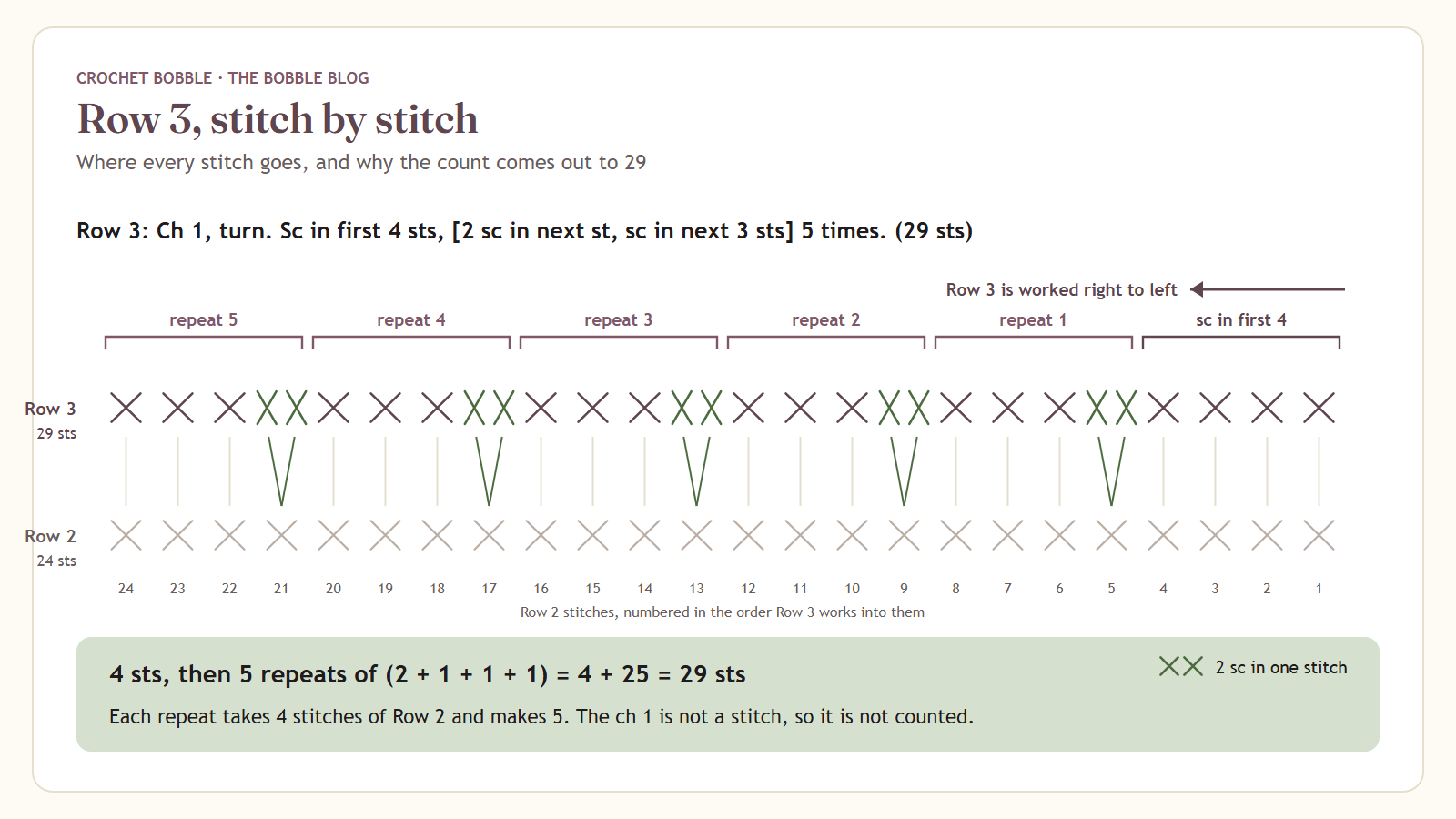
Three habits live in that one line.
The stitch count at the end of every row. If I could make only one rule, it's this one. It's how your reader knows they're on track before a missed stitch becomes a slanted edge twenty rows later. (Counting stitches is its own skill, and worth one.) Crochet Bobble's pattern builder has a Check this pattern button that reads every row back and points out any row whose count, words and chart don't agree.
Saying whether the turning chain counts. In single crochet it usually doesn't. With double crochet, the ch 3 usually does. With half double crochet it varies from designer to designer. Pick one, say which in your notes, and stay consistent all the way through.
Brackets for repeats. The CYC's symbols, and what each one means:
- Brackets [ ] mean you work what's inside as many times as the pattern says.
- Parentheses ( ) get two jobs from the CYC: repeating, the same as brackets, or a group of stitches all worked into the same stitch or space, like (2 dc, ch 2, 2 dc) in the next space.
- An asterisk (*) marks the start of a section you repeat, and the pattern tells you how many times or how far.
Because parentheses can mean either thing, I keep them for stitches that all go into one place and use brackets for every repeat. Your reader never has to guess which one you meant. Whatever you pick, use the standard abbreviations, and spell out anything unusual at the top.
Chart it, too
A symbol chart shows every stitch exactly where it sits. For lace, motifs and anything worked in rounds, many crocheters find a chart faster to read than words, and a pattern with both lets each reader choose. Use the standard stitch symbols so your chart reads like everyone else's.
Then hand it to someone else
You can't test your own pattern, because you already know what you meant. Before you publish it, and especially before you sell it, have a few other crocheters make it from your words alone. Fix every place they had to stop and ask a question. Each of those stops is somewhere a stranger would have gotten stuck with nobody to ask.
Crochet Bobble opens November 24 in the US, with a pattern builder for exactly this: draw your chart with the standard symbols, turn each row of your chart into written words with its stitch count, and print the pattern with both. And yes, you'll be welcome to sell what you design with it. Join the waitlist (US only).
Every tool you reach for, in one place
Crochet Bobble keeps what yarn you already own, which row you were on and how much a blanket will take — one app instead of a notebook and four others. The stitch school opens later, and joining now gets you both.
Crochet Bobble opens November 24 — waitlist members get 2 months free at launch, then the founder price of $7.99/mo for as long as you stay. US only for now.
Live somewhere else? Get an email when we open in your country.
It looks like you’re outside the United States. Crochet Bobble is only open in the US for now — the list for everywhere else will tell you when it opens where you live.
You’re on the list — thank you! Look for a note from hello@crochetbobble.com. Don’t see it in a few minutes? Peek in your spam or promotions folder, and mark it “Not spam” so the next ones find you.
That didn’t go through. Please try again, or email hello@crochetbobble.com.
Notes from readers